
Diagnostic · By Grapevine Heritage Plumbing
The main water line — the service line that carries water from your meter at the street to your house — is one of the few pipes in your home you cannot see. It runs underground, usually buried a couple of feet down through the yard, and when it springs a leak, the water quietly disappears into the soil. There is no dripping under a sink to catch your eye and no stain on a ceiling. For weeks the only evidence is subtle, which is exactly what makes these leaks expensive.
Here in Grapevine, we see more of these than homeowners expect, and the culprit is usually the ground itself. The Blackland Prairie clay under most of the mid-cities swells when it is wet and shrinks when it dries, and that constant seasonal movement puts real stress on a buried line year after year. Add decades of hard-water corrosion from the inside, and older service lines start to give.
The good news is that an underground leak leaves a trail if you know what to look for. Here are the seven signs that point to a main water line leak, roughly in the order homeowners tend to notice them.
Sign 1: Your Water Bill Jumps for No Reason
The most common first clue is a water bill that climbs without any change in how your household uses water. Because a service line leak runs continuously — day and night, whether anyone is home or not — it shows up as a steady, unexplained increase on your statement.
Pull out a few months of bills and compare. A gradual creep can mean a small leak getting worse; a sudden doubling points to a more significant break. Either way, when the usage number rises and nothing in your routine explains it, water is going somewhere you are not seeing. On a buried line, that somewhere is the yard.
Sign 2: A Soggy, Sunken, or Extra-Green Patch in the Yard
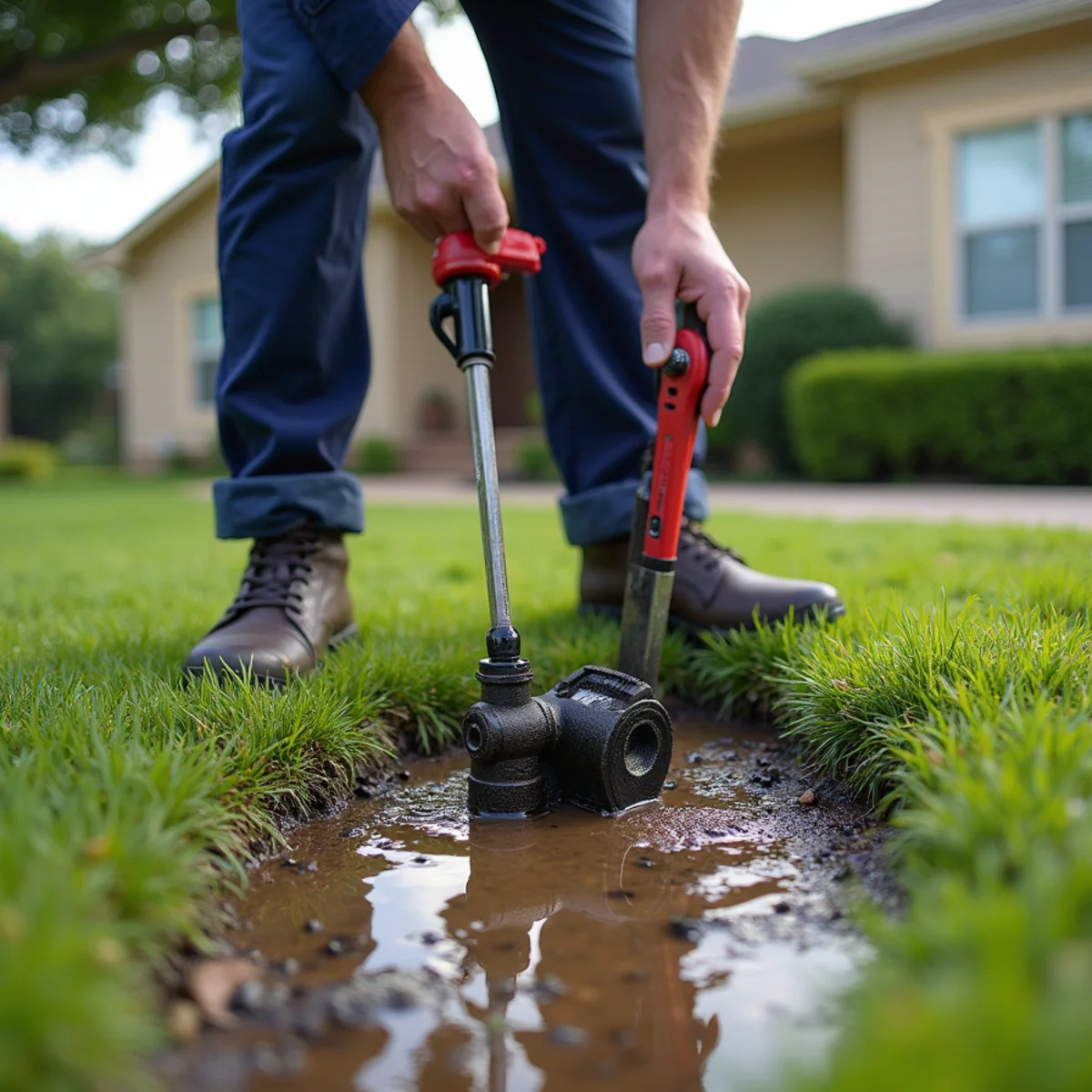
Water escaping underground has to surface somewhere, and often it shows up in the lawn. Watch for a patch of yard that stays soggy or muddy when it has not rained, especially in a line roughly between your meter at the street and the house — that is where the service line runs.
The vegetation gives it away too. Grass directly over a leak often grows faster, thicker, and greener than the lawn around it, fed by the constant water. In other cases the saturated soil erodes or compacts and you get a low, sunken spot. Any of these over the path of your service line, in dry weather, is a strong tell.
Sign 3: Water Pressure Drops Throughout the House
When a meaningful amount of water is escaping before it reaches your fixtures, the pressure at your faucets and showerheads falls off. The key word is throughout — a single weak faucet usually points to a local problem like an aerator or that one fixture, but pressure that has dropped across the whole house points upstream, toward the service line or the meter.
If showers have gone weak, the kitchen sink fills slowly, and it is happening everywhere at once, the line feeding the house is a prime suspect — particularly if it came on gradually over weeks rather than all at once.
Sign 4: The Sound of Running Water When Everything Is Off
Turn off every fixture and appliance that uses water, then stand still in a quiet part of the house and listen. A faint hiss, trickle, or continuous rushing sound with nothing running is a classic sign that water is still moving through your system — escaping somewhere.
On a main line, you may hear it best near where the line enters the house. It is a subtle sound and easy to miss with the TV on, but in a quiet house it is often the clue that confirms what the water bill first suggested.
Sign 5: Cloudy or Dirty Water From the Tap
A break in a pressurized underground line does not only let water out — when pressure drops, it can let soil, sediment, and air be drawn in. If your water has turned cloudy, murky, or you are getting spurts of air from faucets that used to run clean and steady, a compromised service line can be the reason.
Air in the lines and a sudden change in water clarity, taken together with any of the other signs here, strengthen the case considerably. This one is worth taking seriously, because a line open enough to pull in dirt is also a path for contamination.
Sign 6: Cracks or Shifting Around the Foundation
This sign is specific to our soil, and it is one Grapevine homeowners should not ignore. A leaking line saturates the clay around and under part of the foundation. That clay swells where it is wet while staying shrunk where it is dry, and the uneven movement shows up as new cracks in drywall, doors and windows that suddenly stick, or hairline cracks creeping across the slab or exterior brick.
Foundation movement has many causes, and not every crack means a leak. But when new cracking appears alongside a high water bill or a soggy spot in the yard, a leaking service line feeding water under the foundation deserves a hard look before you call a foundation company.
Sign 7: Potholes, Erosion, or Water at the Street
Sometimes the evidence shows up out by the curb. If the service line leaks near the meter or under the driveway, you may see water seeping at the street, a persistent damp spot on the pavement, or soil washing out and leaving a dip or small sinkhole along the line's path.
Keep in mind the responsibility line: generally the homeowner owns the service line from the meter to the house, while the utility owns the main in the street and often the connection at the meter. If water is pooling right at the meter or on the city side, that is worth a call to the utility; if it is between the meter and your house, that stretch is yours. A plumber can tell you which side of the line the leak falls on.
How to Confirm a Leak: The Meter Test
Before you call anyone, you can run a simple test that strongly confirms a leak and costs nothing. Here are the steps:
1. Turn off every water-using fixture and appliance in and around the house — faucets, ice maker, irrigation, washing machine, everything.
2. Find your water meter in its box near the street and look at the dial. Many meters have a small triangular or star-shaped low-flow indicator that spins when any water is moving.
3. With everything off, watch that indicator. If it is still turning, water is flowing somewhere in your system even though nothing should be using it.
4. For a more definitive check, read the meter's main number, wait an hour or two with all water off, and read it again. A number that climbed with nothing running confirms a leak.
5. To narrow down whether it is inside the house or out in the yard line, close the main shutoff where the line enters the house and repeat the meter check. If the meter still moves with the house isolated, the leak is in the buried service line between the meter and that shutoff.
That last step is genuinely useful — it separates a yard-line problem from an inside-the-house problem and tells us where to focus. When you call, tell us what the meter did; it saves time on site.
How Grapevine Heritage Plumbing Can Help
Frequently Asked Questions
As a general rule, the homeowner owns the service line from the meter to the house, and the utility owns the main and often the meter connection. If water is pooling right at or before the meter, call the utility. If it is between the meter and your home, that run is yours. A plumber can locate the leak precisely and tell you which side it falls on.
A main water line leak hides underground, but it rarely hides completely. A climbing water bill, a soggy or unusually green patch of yard, falling pressure, the sound of running water, cloudy taps, new foundation cracks, or water at the street — any one is worth attention, and two or more together make the case. The meter test will usually confirm it in an afternoon.
If the signs point to a leak in your Grapevine service line, do not wait for the bill or the foundation to get worse. Call Grapevine Heritage Plumbing at (831) 290-4327 and we will pinpoint the leak with electronic detection and give you honest repair-or-replace options.